
The Stockholm Prize
in Criminology
The Stockholm Prize in Criminology is an international prize awarded annually to one or more persons for outstanding achievements in criminological research or for the practical application of research results in crime prevention and the promotion of human rights.
Live broadcast of today’s award ceremony
On Tuesday, 9 June, the 2026 Stockholm Prize in Criminology will be awarded. The live broadcast starts at 18:20.
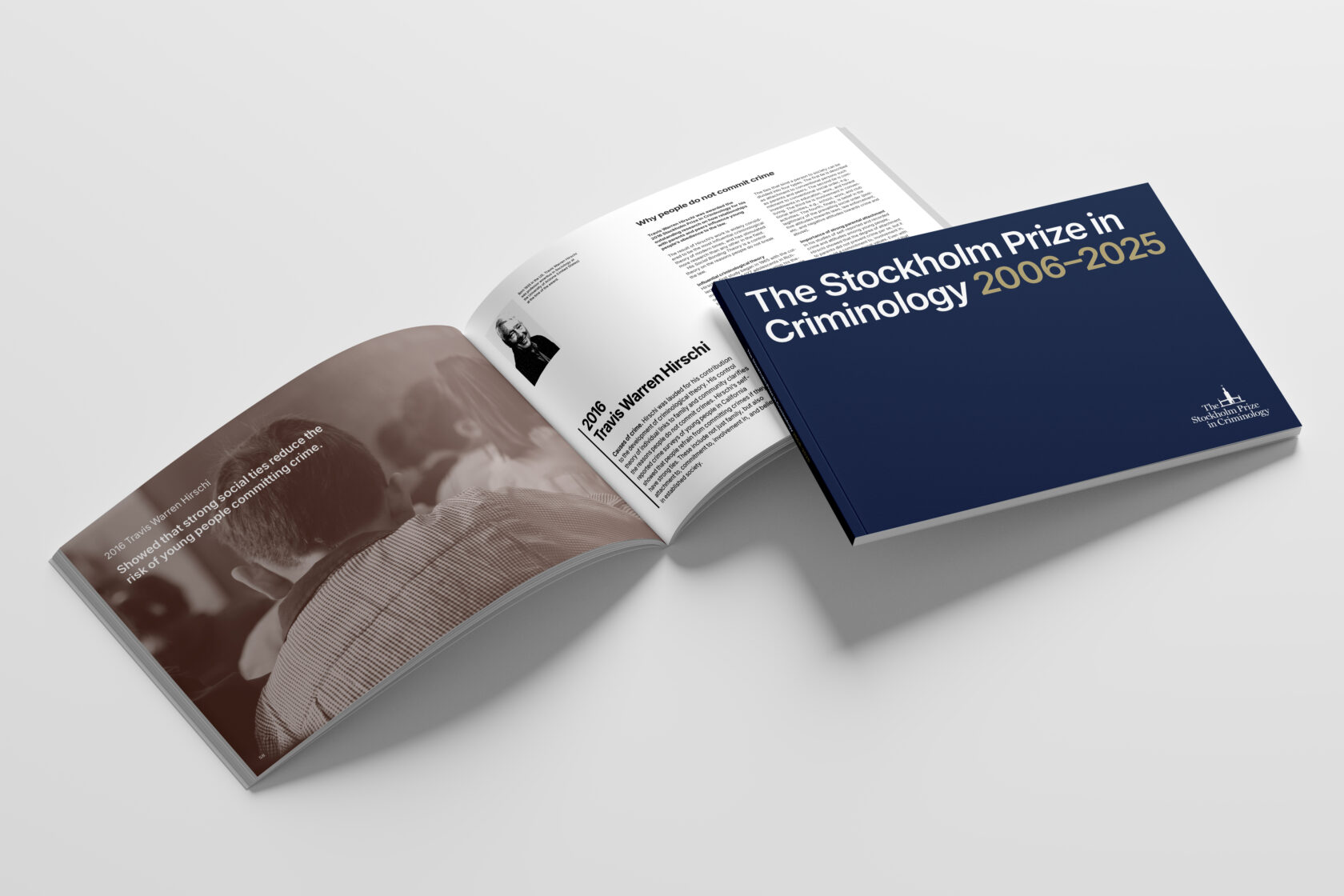
The anniversary publication commemorates the 20th anniversary of the Stockholm Prize in Criminology. It explains the background of the prize and the importance of criminological research in a democratic society. It also presents all the laureates over the years and their research.
‘High-quality criminological research is essential for understanding the causes of crime and developing crime prevention strategies. Criminological research therefore contributes to the legitimacy and effectiveness of the justice system and to support for victims of crime. Criminology is an interdisciplinary discipline that involves several key areas of research, such as sociology, law, psychology, medicine and social anthropology etc. Research is essential for understanding and solving complex societal problems.
The Stockholm Prize in Criminology honours the world’s leading researchers, or the application of research results by practitioners, for the reduction of crime and the advancement of human rights. Representing the founders of the Stockholm Prize in Criminology Foundation, we cannot emphasise enough the importance of profiling and discussing each year the latest leading international criminological research, with Stockholm as our base.’
Gunnar Strömmer,
Minister for Justice, Sweden
Maria Söderberg,
Chair, Torsten Söderberg Foundation
Laureates 2025
Frances Crook

Frances Crook was awarded the 2025 Stockholm Prize in Criminology for her work in reducing the extent of disproportionate sentences and promoting rehabilitation in the United Kingdom’s legal system. As Chief Executive of the Howard League for Penal Reform, she made outstanding use of criminological research to reduce disproportionate sentences and promote more humane and effective sentencing methods. Her efforts have resulted in significant changes in the United Kingdom’s legal system, including a major reduction in the imprisonment of children and young offenders and improving conditions for all prisoners.
Bryan Stevenson

Bryan Stevenson was awarded the 2025 Stockholm Prize in Criminology for his work in opposing the use of death and life sentences without the possibility of parole, and defending the fundamental rights of young offenders and marginalised groups in the American legal system. As founder and Executive Director of the Equal Justice Initiative (EJI), he has applied findings from criminological research to successfully advocate for the banning of executions and life sentences for young offenders.
Previous winners 2006-2025
The Foundation
The Foundation’s work during the year
Jan
Reminder to nominate award winners for next year distributed.
Feb
Reminder to nominate award winners for next year distributed.
March
April
May
Nominations for next year’s award winners will close on May 15.
Nominations for next year open.
The jury starts voting to select next year’s winner.
June
The jury meets to decide next year’s winners.
Proposals are presented to the Foundation’s Board of Directors, which decides.
The Stockholm Criminology Symposium and Award Ceremony takes place.
July
Aug
Sep
Oct
Nov
Announcement of next year’s winners.
Dec
The Stockholm Criminology Symposium
The Stockholm Criminology Symposium is an annual three-day forum arranged in conjunction with Stockholm Prize in Criminology. First held in 2006, it attracts around 500 participants from some 30 countries.
Criminology
Criminology is the study of actions that are punishable by law (i.e., crimes) and other behaviours that, although not punishable, violate societal norms and cause harm to individuals and society.